Can't really think of an intelligent manifesto to baptise this blog with, so I'll just move on to the first idea that comes to mind.
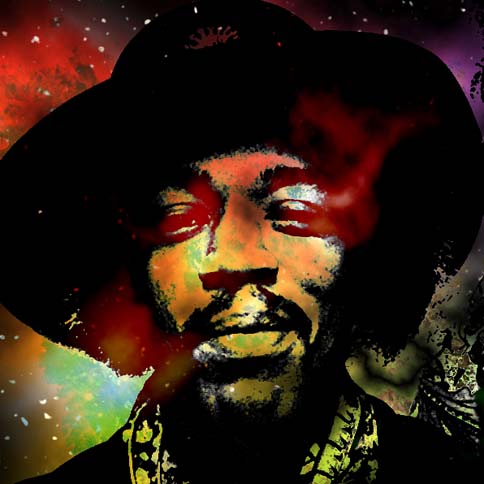
Been listening to Jimi Hendrix today and thinking about the distinction between so-called 'real' music and 'fun' music. What is it that makes-up for this gap? Why is it that many people don't consider electronic music (e.g. house, techno, electro) to be 'real' music, of equal worth to music such as rock, blues, jazz?
Lets look at the possible explanations one-by-one:
Is it because electronic music is produced usually by one person (the produced/DJ)?
Surely not, since a large portion of 'real' music is made by solo artists.
Maybe it's because electronic music is made using non-acoustic instruments and, specifically, mainly computer software and/or hardware...?
This is not a very plausible explanation, seeing as much of 'real' music involves non-acoustic instruments (e.g. electric guitars). Also, using a keyboard or a computer-attached synthesiser which simulates the sounds of other 'real' instruments is not very different from directly playing those instruments.
Some people say that electronic music is fast, easy and cheap to produce...
This is not always true, though. Most accomplished producers spend a vast amount of time in the studio, and may use expensive/sophisticated software and their creative potential to write a song. On the contrary, there are many 'real' musicians (e.g. blues guitarists) who have written songs in a few hours, using only a guitar and their voice, and are nonetheless widely celebrated by conventional musical taste.
How about lack of lyrics?
Again, there are electronic songs with lyrics (either in the form of MCing, or sampled lyrics from other songs or even lyrics of their own) and then there are 'real' songs with no lyrics at all (e.g. classical music).
Then maybe it is because electronic music is usually perceived as being hard on the ear...?
History has proven, though, that accepted musical norms progress along time. Thus, what was yesterday considered mere 'noise' could easily be integrated by mainstream musical tastes tomorrow, as happened with jazz. It is simply another matter of wider progression in human mentality...
Finally, is it because of the purpose for which electronic music is made, mainly to entertain, that it is downgraded by conservative critics?
This is the only strong argument of these critics. Music geared solely towards the cause of 'fun' will inevitably be of limited depth, since it must be levelled-down in order to be easily appreciated by people who wish to combine socialising with dancing and are possibly also under the influence of drugs/alcohol. However, there are certain forms of electronic music not made for purposes of entertainment which require some musical sophistication to be appreciated.
In short, the dichotomy between 'real' and 'fun'/'fake' music is entirely abstract, artificial, unnecessary and, in fact, inaccurate. That said, nevertheless, it is true that a proportionally larger part of electronic music aims exclusively at being entertaining and commercially successful, compared to 'real' music. However, this is not related to some inherent feature of electronic music, but rather to the way it is manipulated by the music industry and, in turn, to how artists respond to such manipulation. On a final note, it is clear that sub-genres of electronic music are emerging that are becoming increasingly more sophisticated, by exploiting the virtually infinite potential of appropriate software. It would not be an exaggeration to predict that some day electronic music will probably surpass 'real' music as the proponent of the values which 'real' music encompasses today...
Having said all this, I'd still pick Jimi Hendrix over possibly any producer on any given day of the year...
R.I.P. Johnny Allen Hendrix (1942-1970).
The good guys always die too early...
PEACE.

No comments:
Post a Comment